The Agent and the House Help
Meta launched Muse in the US on 8 September. Within six weeks it had about 2.5 million daily users, by Sensor Tower's estimate.1 Meta hasn't published a single figure on what Muse bought for anyone. Instinct, a personal agent with 14 staff, raised $1 billion at a $10 billion valuation in September. Its founder says it is approaching $1 billion a year in transactions, half of it travel. Nobody outside the company has checked that number.2
That's the state of consumer agents in late 2026. A lot of money, a lot of downloads, very little proof that the agent does the buying.
What agents do today
Look past the launches and the gains sit in two places: search and recommendation. Amazon says its shopping assistant added about $12 billion of sales in 2025.3 That is a better recommendation engine. The agents that act alone have struggled. ChatGPT Agent reportedly lost at least three quarters of its paying users within months.4 OpenAI pulled Instant Checkout 156 days after launch and moved purchases into retailers' own apps.5 In a survey of 2,000 shoppers in the US and UK, 61 percent used AI to discover products and 55 percent would not let an agent buy for them.6
So the real change so far is about trust. You used to trust Google to surface the best options and then choose yourself. Now you are asked to trust an agent that knows your taste and makes the choice for you. Most people aren't there yet. When Instinct started sending taste picks drawn from users' email, some users described the feeling as "the ick."7
How the emerging world uses it
In Lagos and Nairobi, people use AI. Among Nigerians who are online, 88 percent have used a chatbot.8 The World Bank puts AI use among formal firms in Nigeria and Kenya at about 40 percent, close to 43 percent in the US.9
The gap is in depth. Microsoft's measure of AI use puts Nigeria at 10.1 percent of working-age adults and the US at 31.3 percent.10 Only about 5 percent of ChatGPT's users pay.11 Anthropic finds that use rises with income, and that people in lower-income countries hand the model a task more often than they work through it together.12 What I see is people using AI to rethink and dress up old knowledge. Coursework, a better email, a cleaner CV. At scale, almost nobody is building on it.
The builders tell the same story. GitHub counts about 26 developers working on AI projects per million people in North America and about half of one per million in Sub-Saharan Africa.13 Nigeria only cleared GitHub's reporting threshold for AI work in mid-2025.
The three prices
In emerging markets price is always the marker, and three prices are in play.
The first is data. A gigabyte in Nigeria costs about 0.2 percent of average monthly income.14 A text chat with an AI uses very little of it. Data is rarely the barrier.
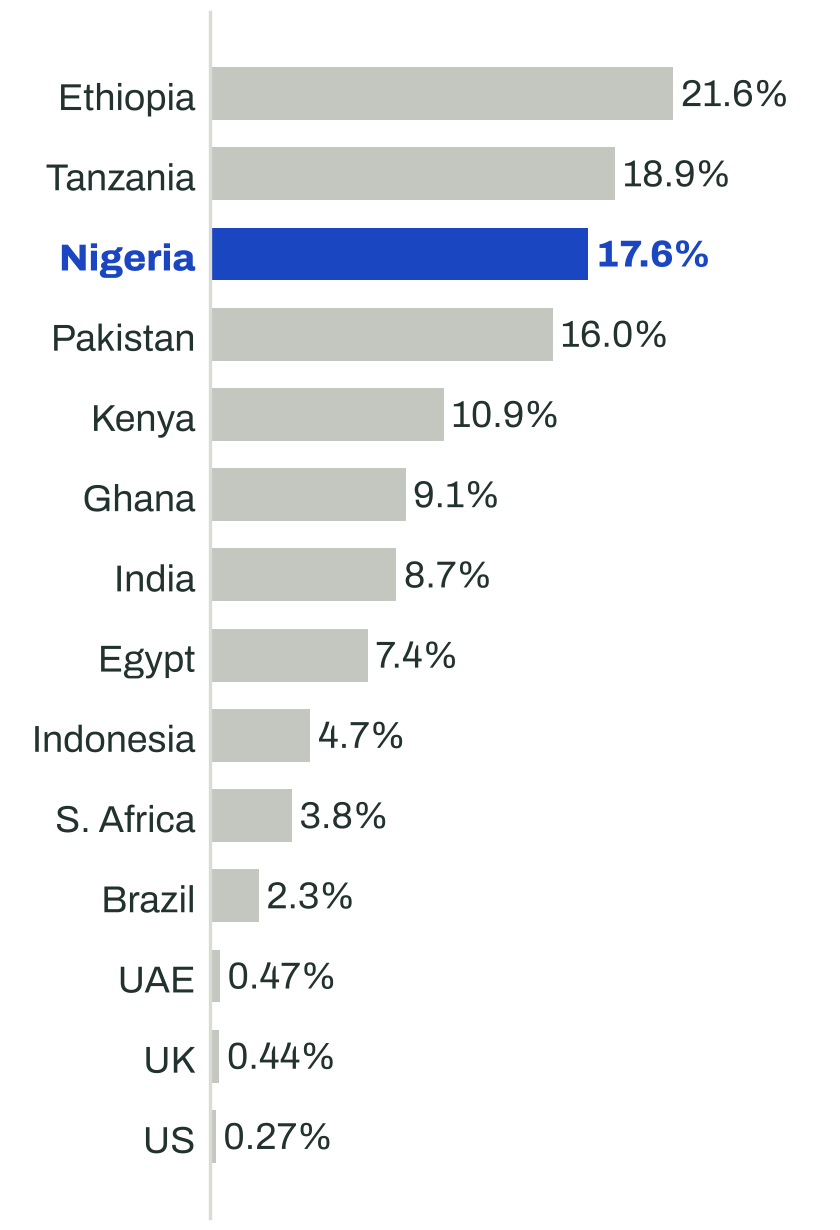
The second is the tool. A $20 subscription is 0.27 percent of average monthly income in the US. In Nigeria it is 17.6 percent. In Kenya, 10.9 percent.15 The same tool costs a Nigerian 65 times what it costs an American. That alone explains why use stays on the free tier.
The third is labor. The cost of life sets the wage, and the wage sets what an agent has to beat. A customer service agent in Lagos earns around ₦150,000 a month, about $112.16 Load that for supervision, seat and statutory costs, and a person handles a customer contact for about $0.34. In the US the same contact costs about $11.28. An off-the-shelf AI service charges around $0.99 per resolved contact.17 Western vendor pricing is set against Western wages. In Lagos, the person is still cheaper. It's the same labor math that holds robots back in The Leapfrog That Isn't.
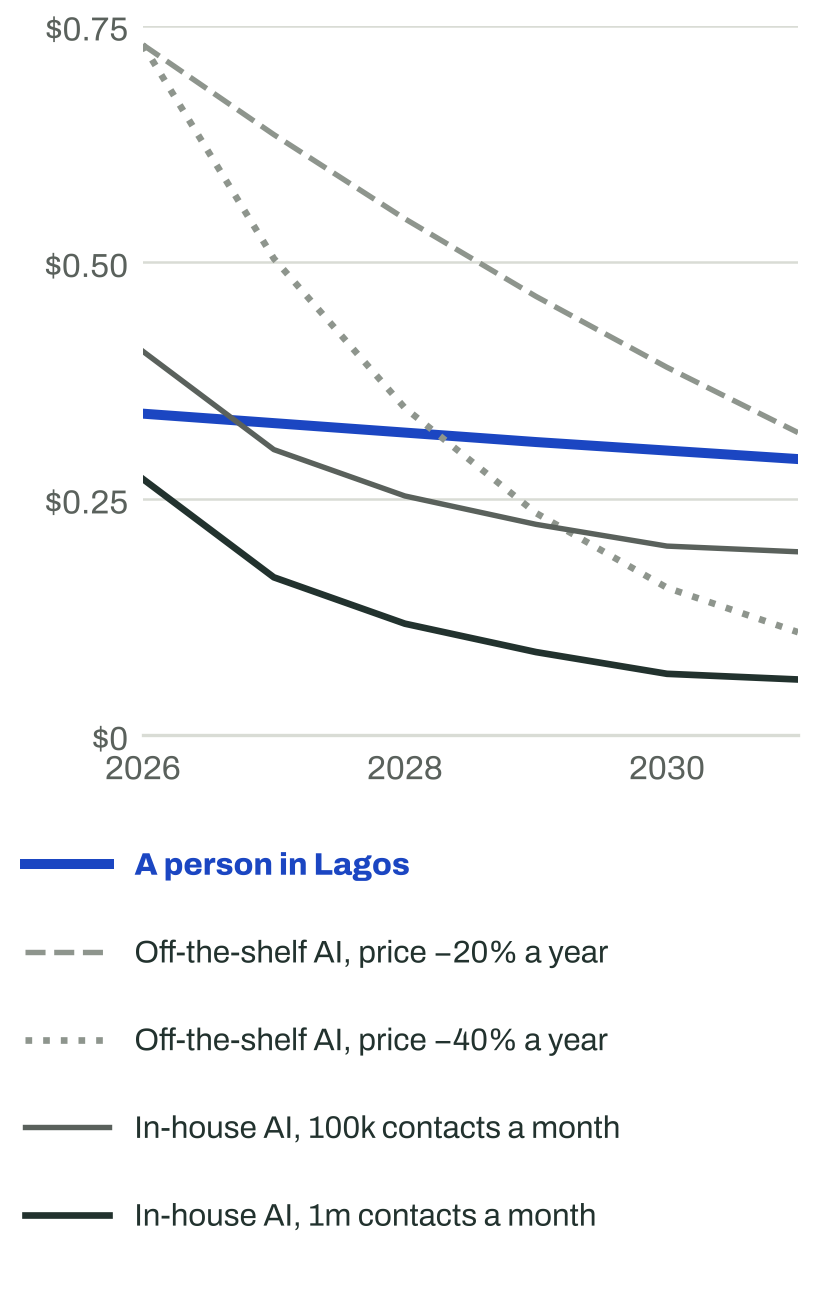
That changes as model prices fall. Epoch measured the cost of reaching a fixed level of performance falling between 9 and 900 times a year, depending on the task.18 A simple model of a Lagos support operation projects that a platform handling a million contacts a month on its own AI is already cheaper than people. At 100,000 contacts a month it would cross in 2027. A company buying an off-the-shelf service would wait until 2029 at the earliest. Scale wins first.
If price isn't yet the question, quality and monitoring might be. Klarna cut the time to resolve a query from 11 minutes to 2.19 A year later its CEO said the AI-first approach "wasn't the right one" and it started hiring people back.20 An AI can read every conversation a support team has. A manager reads a sample. That's where the first real gain may come from: checking the quality of all the work before replacing any of it.
Where disruption lands
The kind of work matters as much as the price. Services delivered over the web will see disruption. The ILO estimates that 34 percent of jobs in high-income countries are exposed to generative AI, against 11 percent in low-income countries, because exposed work (clerical, finance, customer service) concentrates in rich economies.21
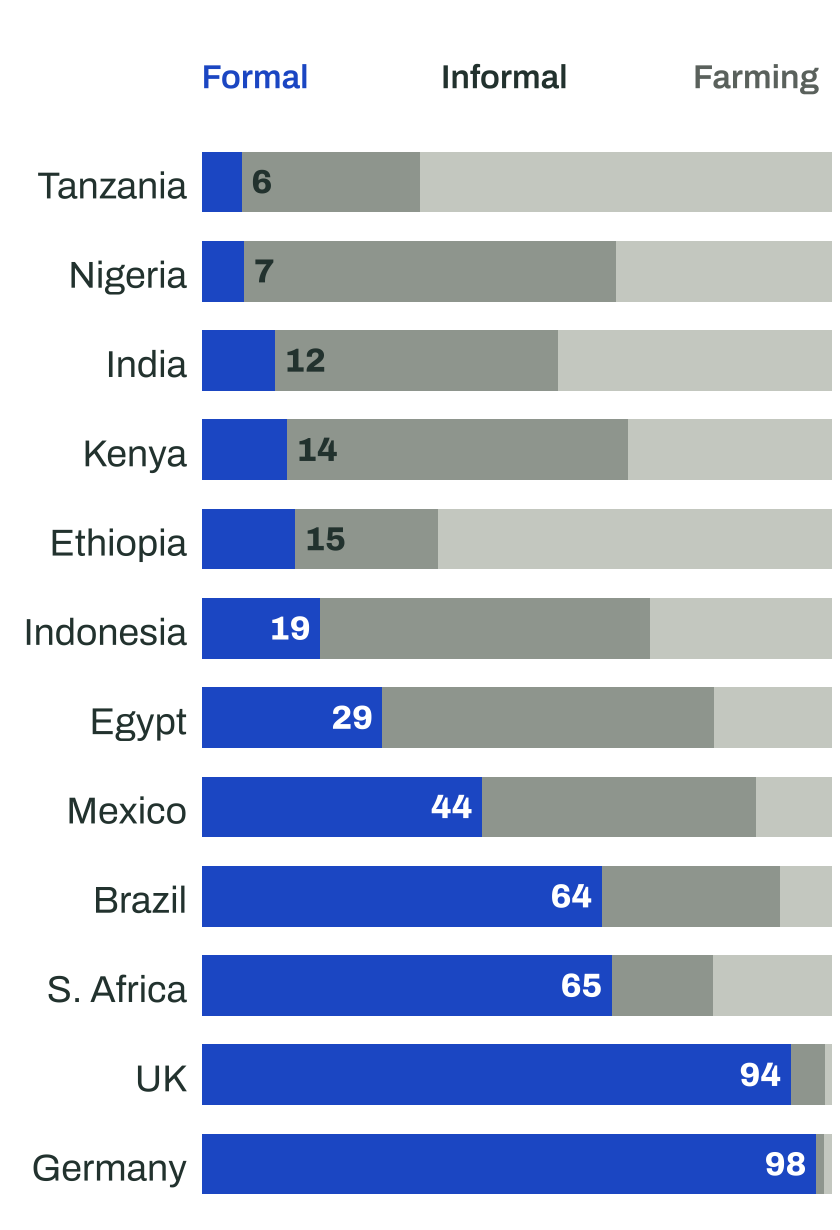
Nigeria doesn't lack services. Services were 56 percent of GDP at the end of 2025. Oil was 3.5 percent over the year.22 The services are informal, in person and run by one person. Seven in 100 Nigerian workers hold a formal job. In Kenya it is 14. In Germany, 98.23 Most work happens in markets, on roads and in homes, where a language model has little to replace.
Offline services like ride-hail and delivery run on dispatch, and dispatch is close to peak functionality. Think of the fork or the spoon. They have been around for thousands of years and there isn't much left to improve. Lyft's reinforcement-learning dispatch, rolled out in 2021, added about $30 million a year against a mature system, under 1 percent of its revenue.24 Useful at scale. Not a revolution.
The inputs still need work. Maps go out of date, and phone GPS drifts on cheap handsets and weak signals. We build our own maps for that reason. Grab did the same in Southeast Asia and reported an error rate four times lower than a leading third-party provider.25 A fleet that drives every street every day keeps a map current more cheaply than anyone else can.
Coordination without density
Ride-hail works because demand is dense. Many people want the same simple thing within minutes of each other, so an algorithm can match them. Most of life outside the home is different. Shopping, the children, an errand across town. Each request is scattered and different. It needs someone to understand it, find the right person, agree a price and follow up. That's concierge work, and it doesn't need density to run.
It has failed before. Magic, the US text concierge, charged a fee of $5 to $20 an order in 2016 for work done by human assistants.26 Homejoy raised $64 million for home cleaning and closed after five years, with customers and cleaners striking deals off the platform.27 Jumia closed food delivery across seven markets, Nigeria and Kenya included, at the end of 2023, citing "very challenging economics."28 In each case the coordination cost too much for the value of the job.
Two things are different now. Coordination is talking, arranging and following up, which is the part AI does well and does cheaply. And in emerging markets, most middle-income homes already have a house help. There are 62 million domestic workers in developing and emerging economies.29 In Nairobi the legal minimum for a house help is KSh 18,047 a month, about $140.30 What the house help lacks is access. They know the prices at their market. They can't see options beyond it, or the household's taste, or which tailor or plumber is reliable. Most goods in Nigeria move through open markets that have no listing, no price page and no reviews.31
So the agent sits on top. It decides what to get, where and at what price, to this household's taste, and the house help does most of the running. Tasks that need more (a vetted specialist, a document taken through an office, a job where someone has to answer for the result) float above the house help to people the platform supplies. Part software, part marketplace.
The risk is the one that killed Homejoy. Our own drivers already take trips off the app. A concierge that introduces a good plumber once may never see that customer again. It holds only if the platform keeps adding something after the first job: payment, a guarantee, someone to call when it goes wrong. The trust layer again.
What cities get
More visibility is always good. Coordination at scale brings legibility to businesses and to trade flows: who buys what, from which market, moved how. Those flows can then carry better infrastructure for payments and logistics.
There is already proof of the sequence. Moniepoint lent more than $700 million to Nigerian small businesses in 2025, judging them on transaction data instead of collateral.32 Payments became visible first. Credit followed.
Legibility cuts both ways. James Scott showed that what makes people legible to the state also makes them taxable and controllable, and informal traders often stay invisible on purpose (the theme of The Informal Stack). A trader joins only when being seen pays: credit, faster payment, more customers.
Back to the beginning
To end this, we have to go back to the beginning. To extend prosperity to everyone, we need to give people tools that extend their productivity. Productivity gains mean people have more time to create other things and services for their communities.
As prices crash, the rapid deployment of AI could mean an abundant future for emerging markets. The early numbers point the other way. In early 2026, Microsoft measured AI use at 27.5 percent of working-age people in the Global North and 15.4 percent in the Global South, and found the gap still widening.33 Without the right guardrails, AI could also mean better exploitation of human and non-human resources, and a much higher Gini coefficient.
- Sensor Tower via PPC Land, "Meta's Muse gains 10 million US downloads in 40 days," October 2026. ↑
- AI Weekly, "Instinct raises $1B Series C at $10B," September 2026; TechCrunch, 30 September 2026. Transaction figure is the founder's own, from a podcast. Headcount: OfficeChai, 28 September 2026. ↑
- Modern Retail, "Amazon says its AI shopping assistant is gaining traction," 2026. ↑
- The Information, via The Decoder, January 2026. ↑
- Shopifreaks, "OpenAI scales back its integrated commerce plans," March 2026. Launched 29 September 2025; purchases moved into retailers' apps in early March 2026. ↑
- Riskified survey of 2,000 US and UK shoppers, Q1 2026, via Forkast. ↑
- TechCrunch, "Instinct's new product recommendations are giving some users the ick," 30 September 2026. ↑
- Google/Ipsos, via Gazette Nigeria. Online adults only. ↑
- World Bank, World Development Report 2026, via Nairametrics, August 2026. ↑
- Microsoft, AI Diffusion Report, Q1 2026. Built mainly from desktop data, so likely undercounts mobile-first markets. ↑
- The Information, via The Decoder, January 2026. ↑
- Anthropic Economic Index, geography report, 2025. ↑
- GitHub Innovation Graph, Q1 2026, developers pushing to repositories tagged with AI topics; population from the World Bank. Author's calculation. A lower bound: GitHub reports a topic only above 100 developers per country per quarter. ↑
- Broadband Genie, Global Mobile Data Price League 2026; GNI per capita, World Bank (Atlas method, 2025). Author's calculation. ↑
- As note 14. Average income; median income is lower, so the true share is higher. ↑
- Jobberman Lagos customer service listings, ₦70,000 to ₦250,000 a month, October 2026; exchange rate ₦1,333.64 to the dollar, 21 October 2026. ↑
- Author's model: wage loaded 2x, 11-minute contacts at 70 percent occupancy. US wage: BLS median for customer service representatives, May 2025. AI price: Fin list price per resolution. The chart adds: in-house AI at $0.12 a conversation in model costs, falling 3x a year, plus $15,000 a month of team and infrastructure; AI resolves 60 percent of contacts today, rising 6 points a year to 85 percent, and the rest go to a person; the Lagos wage drifts down 3 percent a year in dollars. ↑
- Epoch AI, "LLM inference price trends," March 2025. ↑
- CX Today, February 2024. ↑
- Tech.co, May 2025. ↑
- ILO Working Paper 140, "Generative AI and Jobs: A Refined Global Index of Occupational Exposure," 2025. ↑
- National Bureau of Statistics, Q4 2025 GDP, via The Guardian Nigeria. Services share is for the fourth quarter of 2025 (55.92 percent); oil share is for the full year (3.53 percent). ↑
- ILOSTAT informal employment, latest year (Nigeria 2024, Kenya 2019, Germany 2022). Formal share is the remainder. ↑
- Lyft, "A Better Match for Drivers and Riders: Reinforcement Learning at Lyft," INFORMS Journal on Applied Analytics, 2024. Share of revenue is the author's calculation against Lyft's 2021 revenue. ↑
- Grab press release, June 2022. ↑
- Fortune, 5 January 2016: "The startup charges a fee that ranges from $5 to $20 per order." ↑
- Harvard Digital Initiative, "Homejoy's not-so-joyous demise." ↑
- TechCabal, 14 December 2023. ↑
- ILO and WIEGO statistical brief, 2022. ↑
- Kenya domestic worker minimum wage, 2026 wage order, reported by Khusoko on 6 June 2026. ↑
- Business Sweden, "The changing pattern of the Nigerian FMCG market" (undated, about 2018): informal retail about 95 percent of sales value. ↑
- The Guardian Nigeria, 2026. ↑
- Microsoft AI Diffusion Report, Q1 2026, via Campus Technology, 18 May 2026. ↑